In an in-depth interview with The Market NZZ, which has been lightly edited for clarity, Wood explains how China’s recovery will affect financial markets, what policies he expects from the Federal Reserve, what’s in it for gold, silver and commodities, and how investors can best navigate through these challenging waters.
Which will allow the Fed to declare victory and end this tightening cycle?
Yes, that’s my base case. They will cut rates once they realize there will be a recession or when we start to get real distress in the financial system. The key point will be whether the Fed gives greater priority to fighting recession over getting inflation below its 2% target. My base case remains that the Fed will fudge their 2% target. With that happening, my longer term base case is that we will see a period of structurally higher inflation in the coming years, which will be positive for equities but negative for government bonds.
What if not?
If I’m wrong and if the Fed keeps tightening all year and continues to shrink its balance sheet, then I think inflation will completely collapse and then you can make a lot of money owning Treasuries. But I don’t think that’s very realistic politically.
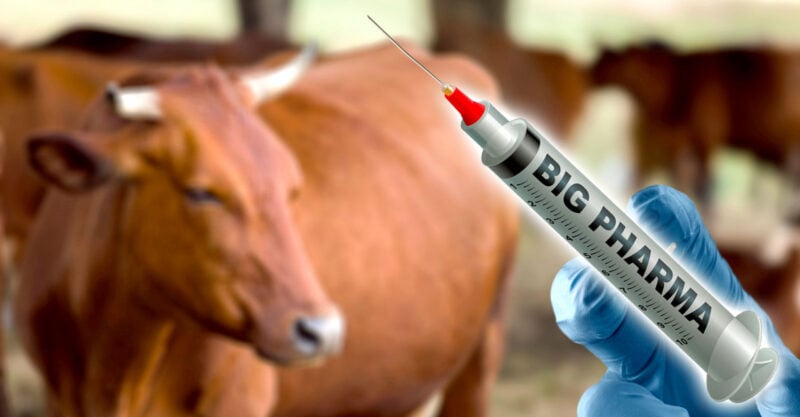
If cattle and livestock farmers start pumping their animals with mRNA vaccines, that will be the end of eating out meats for me unless it is 100% grass-fed beef.
COVID Vaccines ‘Opened the Floodgates’ for New Wave of mRNA Vaccines for Livestock
Several new government- and industry-funded studies are underway to develop mRNA vaccines for livestock, but “we need to be sure that no abnormal cellular or molecular changes to the animal could be induced by this type of vaccine,” one scientist told The Defender.
Several new government- and industry-funded studies are underway to develop mRNA vaccines for livestock, part of the massive expansion of the animal vaccine industry projected to be worth $26.12 billion by 2030.
Researchers at Iowa State University are undertaking a project funded by the U.S. Department of Agriculture to develop mRNA vaccine technology to prevent bovine respiratory syncytial virus (RSV).
“Third generation vaccines,” including DNA, RNA and recombinant viral vector vaccines, are not only administered to livestock — but they also are being developed for companion animals and wild animals.
A peer-reviewed study in the journal Viruses last year reported, “The successful application of mRNA vaccines against COVID-19 has further validated the platform and opened the floodgates to mRNA vaccine’s potential in infectious disease prevention, especially in the veterinary field.”
Citing the need for biosecurity, in September 2022, the New South Wales (NSW) government fast-tracked the world’s first mRNA vaccines for foot-and-mouth disease and lumpy-skin disease, in a five-year multimillion dollar deal with U.S. biotech company Tiba Biotech.
Announcing the deal, Deputy Premier and Minister for Regional NSW Paul Toole said:
“I have now written to vaccine manufacturers to take up my challenge to develop both vaccines ready for use and manufacture in NSW by August 1 next year.
“COVID-19 demonstrated to us that all possible avenues in developing vaccines must be explored and we will leave no stone unturned.”
Dugald Saunders, NSW minister for agriculture, emphasized how important it was to “protect [NSW’s] livestock sector” and said the agreement with Tiba Biotech to create mRNA vaccines, “would be a game-changer for the industry.”
“Not enough is known at this time if mRNA vaccines can generate any long-term effects on reproduction or lifespan of domestic farm stock.
“As livestock become part of the human and animal food chain, we need to be sure that no abnormal cellular or molecular changes to the animal could be induced by this type of vaccine.”
The latest Economic Freedom of North America report issued by the Fraser Institute marks the first time economists have had a full four decades’ worth of data on economic freedom across the fifty United States. Those less familiar with economic research claim that economics isn’t a science because economists can’t conduct controlled experiments. Yet where economists can’t conduct controlled experiments (behavioral economists do conduct controlled experiments), they employ complicated statistical techniques to compensate for the fact that they must take data as they come. Here, the Fraser Institute has given economists a treasure-trove of data that provide insight into the effect of larger and smaller government footprints among the states’ economies.
Economic freedom is not the same as less government. In fact, in many cases, improved economic freedom requires more government. Economic freedom is rather “right government,” government that, as Thomas Jefferson put it in his first inaugural address, would “restrain (people) from injuring one another, (but) shall leave them otherwise free to regulate their own pursuits…” Societies are more economically free when their governments prevent people from harming each other, whether by violence, theft, fraud, defamation, pollution, or any of the many other ways the more powerful manage to exploit the less. But societies are also more economically free when their governments otherwise leave people and businesses alone to make decisions for themselves. Exploitation is as anathema to economic freedom as is the nanny state.
There is no perfect way to measure economic freedom, as is often the case, so economists must settle for reasonable measures. Fraser has constructed a quasi-objective measure of economic freedom. The “quasi” part comes from the fact that Frasier’s researchers had to decide what metrics were consistent with the idea of economic freedom. The “objective” part is that government agencies put numbers to the metrics. In calculating an Economic Freedom index for each state, Fraser combines state and local government spending, government transfers and subsidies, state pension payments, tax rates and brackets, the minimum wage relative to average income, and government employment. Fraser simply averages its metrics together and puts the result on a scale from 0 (least free) to 10 (most free). Reasonable people can argue that some metrics should be weighted more than others, but Fraser tries to keep its researchers’ opinions out of the equation by taking simple averages.
As of 2020, the last year for which Fraser has performed the calculations, economic freedom among the fifty states has ranged from a low of 4.3 (New York) to a high of 7.9 (Florida). On the whole, economic freedom among the states has risen over the decades from a median of 5.2 in 1981 to almost 6.4 in 2020. That’s a remarkable improvement. Even New York State, the least free state in the union, has raised its score from 2.7 in 1981.
From thousands of different dollars, consolidated into one greenback after the civil war under Lincoln, now financing a country heavily in debt, with a break down in the rule of law, capped productivity because of the elimnation of oil in production. Are the dollar’s days numbered?

 My Journey Towards Understanding the Markets