
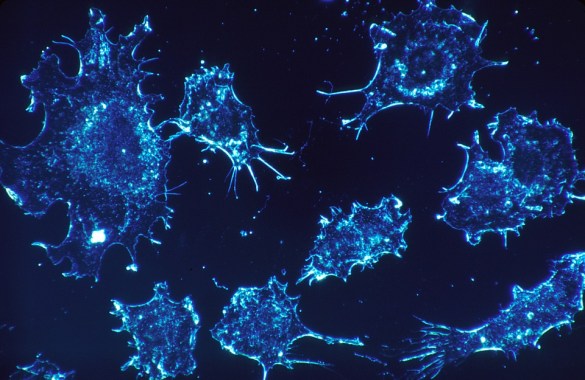
Grace Zhao, a Chinese-born-American scientist who lives in the United States, co-created one of the most non-invasive cancer-detection technologies in the world. Her company, Accuragen, based in Silicon Valley, developed a process that requires one simple-blood draw to detect hundreds of different types of cancer at a benign stage. Current FDA approved technology offers cancer patients only one option when a doctor suspects cancer: a biopsy. By the biopsy stage, the cancer has already become potentially deadly and biopsy requires surgery.
Accuragen’s four founders, all Chinese born Americans, with degrees from from both Chinese and American universities such as Stanford University and University of San Francisco, have found difficulty moving their product to market in the U.S. due to the onerous FDA regulations to obtain approval. While Zhao and her team slog through costly and time consuming American rules, her company’s product has already gone to use in China with great success and demand.
Her company represents one of probably a long list of start-up companies who try to bring a new and promising, life-saving technology to market in the United States only to find they stand up against a brick wall at the FDA that seems more as though it exists to stifle competition and protect the economic interests of the currently-entrenched-large pharmaceutical companies who already offer cancer-detection services.
China, on the other hand, has welcomed her company’s product with open arms, and the Chinese people now have access to cheaper, less invasive, and more sensitive technology that does not involve a knife. What the U.S. offers to cancer patients today will to the Chinese soon look like blood letting from the B.C. era.
Now, I do not think that China right now is the paradigm or paradise of economic freedom and prosperity. Last weekend I posted a documentary about Ai Wei Wei’s incarceration. Ai Wei Wei designed China’s “Bird’s Nest” for the 2008 Olympics. He had his career made. But after a massive earthquake in Sichuan, China in 2008, that killed 5,335 students whom the Chinese government did nothing to account for, Ai Wei Wei went on a mission to remember the young lives that perished. His efforts to both criticize the Chinese government’s cover up on the number of deaths and to remember those who died caused him to become a subversion to the state punishable with incarceration.
His simple desire to speak out freely and create art expressing himself caused his eventual incarceration. The Chinese government demolished an art gallery he built without discussion, with short notification, and without due process of law. If someone of his stature, who’s iconic Olympic Bird’s Nest took center stage as host to China’s foray into the global limelight, cannot have free speech, property rights, or due process of law, China will continue to see difficulties in the years ahead. Economic prosperity and political freedom go hand in hand. You cannot have one without the other.
If, however, China evolves to the point where people can have free speech, have due process of law, and property rights, then I will have much interest in possibly moving there. Accuragen’s success there gives me hope. The U.S. is declining fast into an authoritarian state as you can see with the increase in civil asset forfeitures. http://www.zerohedge.com/news/2017-04-01/dea-has-stolen-32-billion-americans-without-charges-2007
Advancement in technology and science, combined with good work ethics, will continue to prosper in Asia. I just hope political freedom does too.
 My Journey Towards Understanding the Markets
Great piece
LikeLike
good job if you were
LikeLike
thank you
LikeLike